
The Enduring Struggle of the Tagakaulo
Foreign Occupation
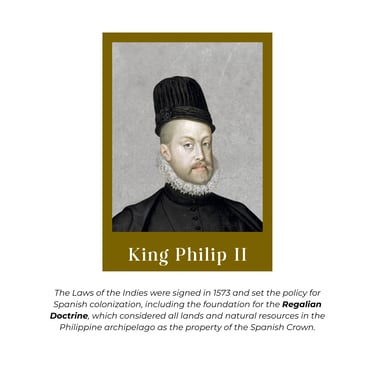
When the Spanish arrived in the 16th century, they claimed all the islands for the King of Spain. Without their knowledge, the Tagakolu people had lost the ownership of their land to a monarch who had never even set foot on the island of Mindanao or on any of the islands, for that matter. It did not matter much to the Tagakolu, though, for they were too far away from the national capital, Manila, to feel the influence of the Spanish crown. However, this would set a historical precedent, the consequence of which would inevitably put all the indigenous peoples of the islands, not only the Tagakolu, at a great disadvantage for generations to come. The Spanish had very little contact with the Tagakolu people during their occupation of the archipelago; their influence was barely felt in Mindanao. This may have been since the Spanish had their hands full defending Manila and, at the same time, did not have the necessary resources to finance the costly enterprise of expanding the crown's reach to the whole of Mindanao. The Jesuit missionaries, however, had mentioned the Tagakolu people in their chronicles as they explored Mindanao in the mid-19th century. However, their mission stations were too far from the Tagakolu to really influence them.

Toward the end of the 19th century, the United States of America purchased the Philippine islands from Spain and refused to acknowledge the legitimate existence of the Republic of the Philippines. As the new owners of the archipelago, the United States took over Spain's claim to the land. Without the knowledge of the Tagakolu, their land had once again been claimed by a people who did not know of them. Unlike the Spanish, however, these new claimants would work vigorously to exploit Mindanao and, on two occasions, would even attempt to sever it from the rest of the Philippines to make it a territory of the United States. American settlers came and encroached on the lands of the Tagakolu. They did not care much for the Tagakolu and other indigenous peoples referring to them as wild tribes, which justified, to their minds, their land grabbing. They established homesteads and forced the Tagakolu to work for them. Many of the Tagakolu workers would abandon their work and seek refuge in the mountains where the American settlers could not follow. One Tagakolu, however, dared defy the Americans. In 1906 Mangulayen, the man charged by the colonial government to oversee his fellow Tagakolu, assassinated the American district governor of Davao who was on his way to Malita.


Philippine Law and Society
Even after the re-establishment of the Philippine Republic in 1946, the Tagakolu continued to be sidelined in the development of their lands and were still not given ample opportunity for self-determination as a people. The passage of the Indigenous Peoples Rights Act (IPRA) in 1997, however, gave new hope to the Tagakolu and other indigenous peoples of the Philippines. The IPRA upheld and defended the rights of indigenous peoples, especially their right to their ancestral domains, of which they had been divested since the arrival of the Spanish in the 16th century. The new law gave new hope, but, regrettably, it did not put an end to the perennial marginalization of the Tagakolu. It is a tragedy today that despite the existence of a law that upholds and defends their rights, the Tagakolu continue to lose much of their land to local politicians, several of whom are even Tagakolu. They conduct themselves like warlords, even more devious than the country’s former colonial masters, with no regard whatsoever for the rule of law. Tagakolu lands are converted into plantations and quarries. Forests are cut, and the lumber is sold. As their land is slowly appropriated by politicians through legal theft, many of the Tagakolu slowly lose their identity as a people as well.
Many of the youth, for example, are enticed by the tempting allure of modern Western living. Through the influence of mass and social media, many are slowly replacing their customs and traditions with practices promoted by a capitalist market economy, leading to the disintegration of the Tagakolu family and society. A large number of them are no longer able to speak their own language properly, preferring to speak in Cebuano, the language of settlers in the lowlands. Another crucial factor in the disuse of the Tagakolu language, besides modern media, is the influence of Cebuano-speaking teachers in government schools. They discourage children from speaking their mother tongue in school and, in many cases, penalize them for speaking it.
Tagakolu farmers are also tricked by the shallow promises of commercial farming. They are made to believe that planting genetically modified seeds and using synthetic fertilizers, herbicides, and pesticides would bring larger and better harvests at reduced costs and less manpower. It does so in the short term but dwindles a few planting seasons later as the land is slowly poisoned by the very chemicals that had previously promised a better life. In the meantime, the cohesion of the community has already been seriously compromised as farmers now regard their neighbors more as competitors and less as partners.





Connect
Join us in spreading faith and hope.
Copyrights © 2025. All rights reserved. | Developed by WhichOnePh
Missionaries of Jesus Villa Ligaya Dela Paz, Antipolo Philippines, 1870